
 Ladungssicherung


 Industrie & Logistik


 Planen & Netze


 Urlaub & Freizeit


Lashing strap label
Lesezeit: 3 minutes
Aktualisiert am: 08.08.2025
Fachtexte von
Ladungssicherungs-Profis
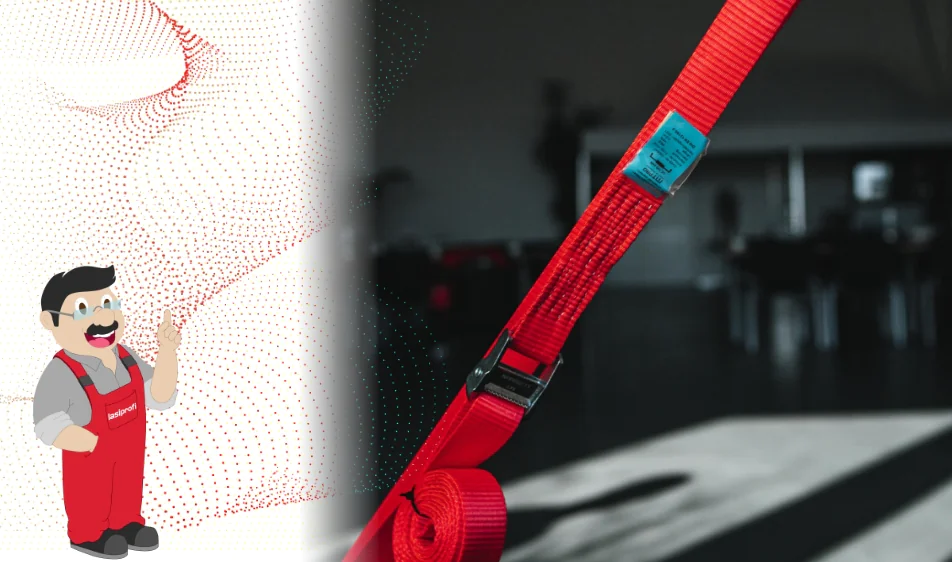
The most important criteria on the lashing strap label explained briefly
Manufacturer
To enable the lashing strap manufacturer to be traced, a code known as the manufacturer traceability code is printed on the label. The manufacturer's details, including their address and the traceability code, must be clearly visible on the lashing strap label and must not be sewn in. The marking on the lashing strap label must comply with European standard DIN 12195-2.
Check digit
Number and part of the European standard and certificate number if a GS mark or TÜV mark is present.
LC (Lashing Capacity)
Lashing capacity is the load capacity of the lashing strap. On older straps, it may also be specified as Fzul (permissible tensile force). LC indicates the permissible lashing force for direct lashing. It specifies when the load limit of the lashing strap has been reached.
STF (Standard Tension Force)
The pre-tension force is indicated by STF, which stands for ‘Standard Tension Force’, also known as ‘normal tension force’. This is the quality feature of lashing straps: the better the quality of a lashing strap, the higher its pre-tension force. It is indicated in daN (decanewtons), with one decanewton corresponding to approximately one kilogram. The Standard Tension Force (STF) is specified in daN when the normal hand force SHF (Standard Hand Force) is reached.
Put simply, STF is the strength of the lashing strap.
SHF(Standard Hand Force)
SHF, also known as hand force or hand pull force, is the force that must be applied to tension the ratchet. The European standard has been set at 50 daN. This means that a weight of approx. 50 kg attached to the ratchet causes the ratchet and lashing strap to be tightened.
Put simply, SHF is the power of the user.
Stretching
According to the standard, a lashing strap may have a maximum elongation of 7%. All lasiprofi tensioning straps have a maximum elongation of 5%.
Year of manufacture
Indication of the year of manufacture.
Material
Material of the strap. Depending on the material used, the labels must have the following colours:
PES webbing -> blue
PA webbing -> green
PP webbing -> brown
Length specification
The lashing strap label must indicate the lengths as LG, LGF, and LG.
LG -> Total length of single-piece lashing straps, measured from the outer turning radius of the attached tensioning elements to the end of the webbing.
LGF -> Length of the fixed end of a two-piece lashing strap, measured from the load-bearing point of the attached end fitting to the outer turning radius of the connection between the strap and the tensioning elements.
LGL -> Length of the loose end of a two-piece lashing strap, measured from the load-bearing point of the attached end fitting to the end of the strap.
Warning notice
Instructions for use: ‘Must not be used for lifting!’
User information
According to the requirements of DIN EN 12195-2, user information must be provided with every lashing strap or lashing strap unit.
Please also read our useful information: Instructions for tightening and loosening the tension strap.
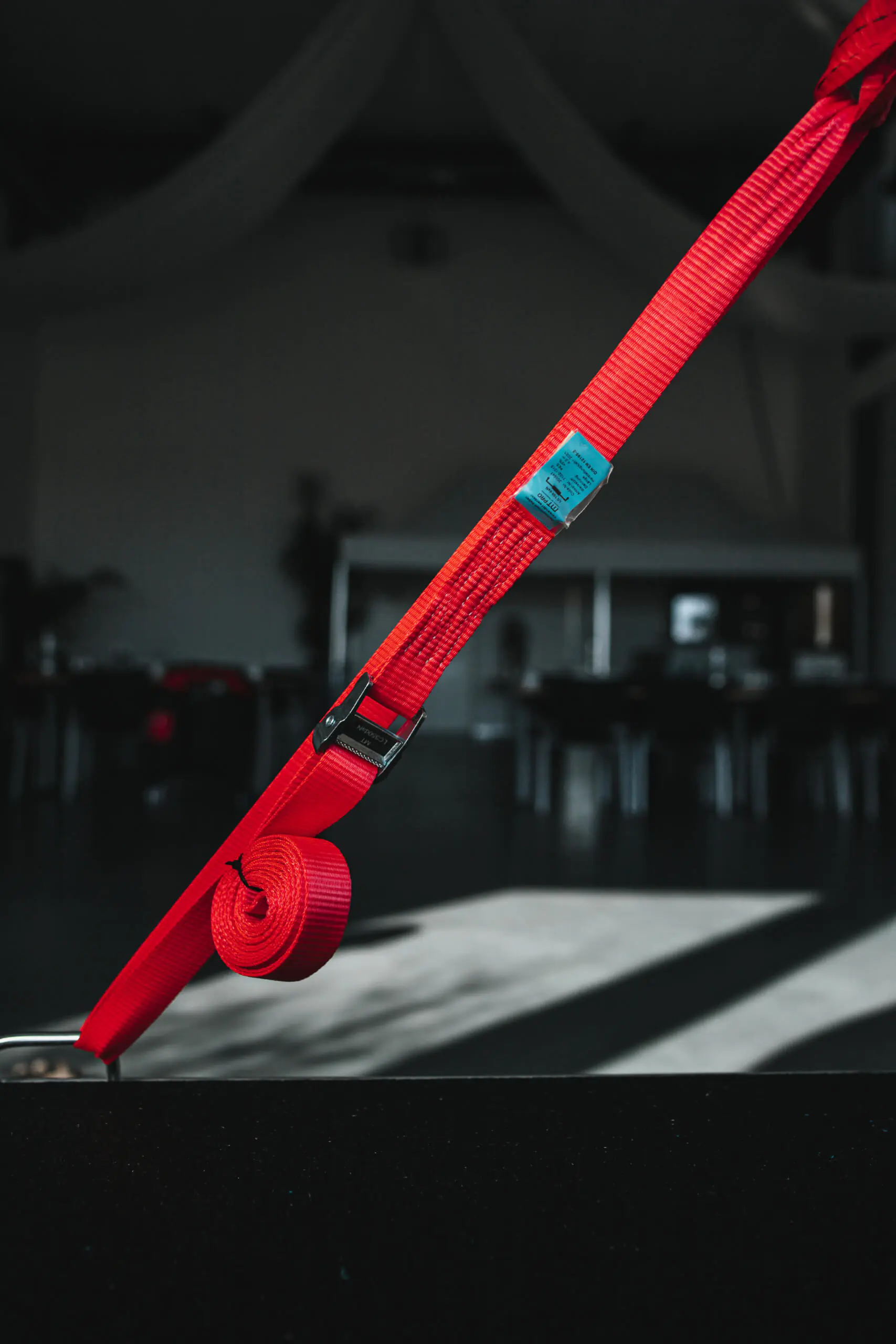
European standard EN 12195 describes the strength of ratchets and ratchet straps, permissible elongation and the requirement that pre-tensioning force and lashing force must be indicated on a label. The lashing strap label on a lashing strap provides the user with a wealth of important information, such as:
- Name and symbol of the manufacturer
- Test number and GS-mark
- Standards according to which the lashing strap
- Normal hand force SHF (standard hand force) in daN
- Preload force STF (Standard Tension Force) in daN
- Permissible lashing force with symbol representation (LC = Lashing Capacity) in daN (1 daN = 10 N = 1 kp = 1 kg)
- Useful length of the lashing device
- Material
- PES (polyester) = blue label
- PA (polyamide) = green label
- PP (polypropylene) = brown label
- Elongation at permissible lashing force, expressed as a percentage
- Year of manufacture
- Code number / traceability code
- VDI compliance
- Warnhinweis: Darf nicht zum Heben verwendet werden! Nur zum Zurren!
