
 Ladungssicherung


 Industrie & Logistik


 Planen & Netze


 Urlaub & Freizeit


Regulations for wheel chocks on motor vehicles
Lesezeit: 7 Minutes
Aktualisiert am: 11.08.2025
Fachtexte von
Ladungssicherungs-Profis
Regulations for wheel chocks on motor vehicles
All motor vehicles registered on our roads must be equipped with two independent braking systems. Each braking system must be capable of functioning independently, even if the other system fails.
In addition, some motor vehicles must also be equipped with wheel chocks. This is regulated in Section 41 of the StVZO (German Road Traffic Licensing Regulations). This section specifies exactly which vehicles and trailers must be equipped with one or even two wheel chocks. This requirement applies first and foremost to motor vehicles with a gross vehicle weight of more than 4,000 kg. Furthermore, two-axle trailers with a permissible total weight exceeding 750 kg must also be equipped with a wheel chock. However, this does not apply to semi-trailers and so-called rigid drawbar trailers. These must even be equipped with two chocks in order to be allowed on the road. Two wheel chocks are also required for vehicles with three or more axles.
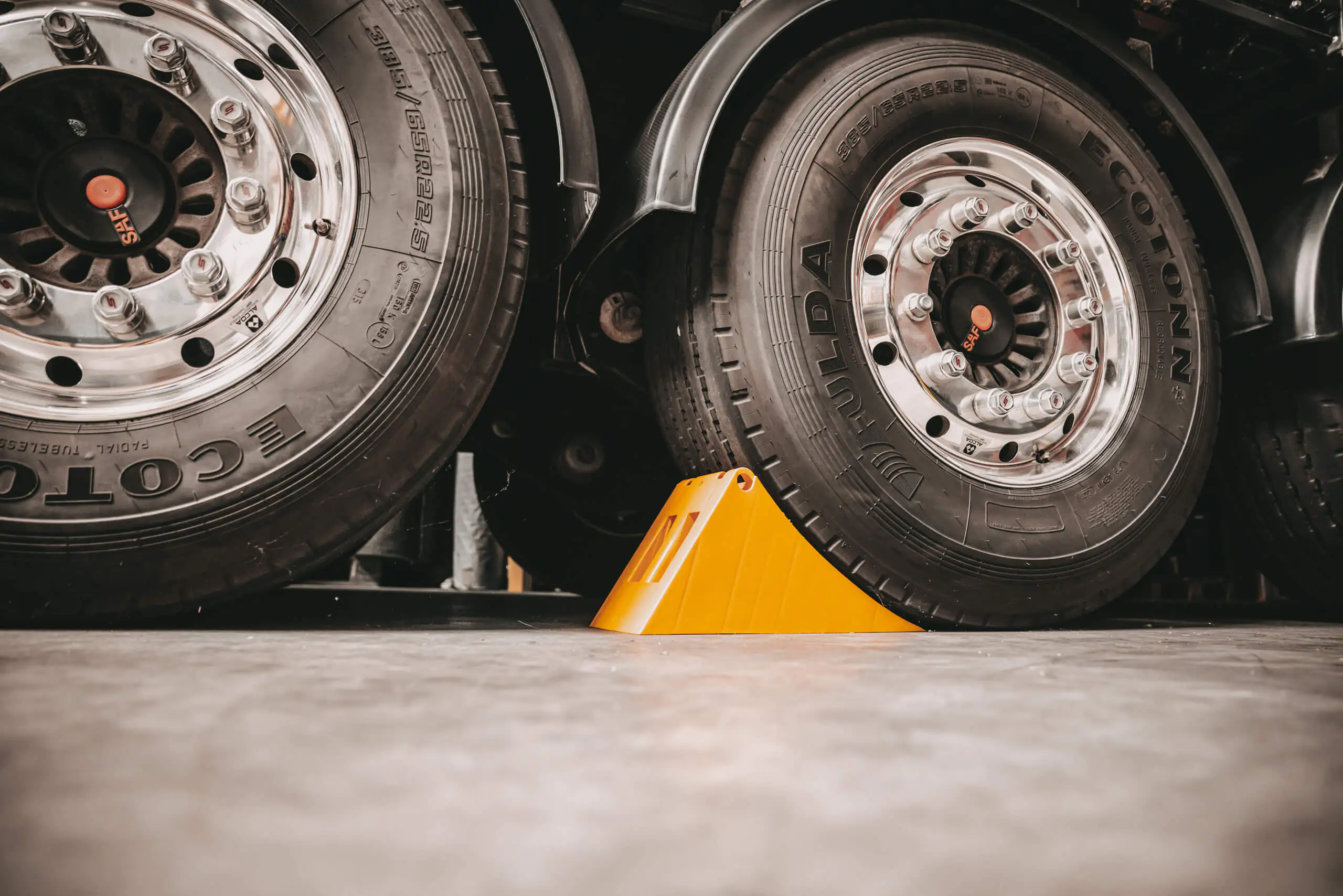
So far, so good. But it is not only the number of wheel chocks that is regulated by law. The specifications for this equipment are also clearly defined. Section 41 of the German Road Traffic Licensing Regulations (StVZO) states that these wheel chocks must be safe to use and, above all, sufficiently effective. Accordingly, these chocks must also be of a size that enables them to effectively stop the relevant wheels. It may well be that a plastic wheel chock is sufficient for a trailer to be towed behind a car if it can be used to secure the trailer against rolling away on a slope without any problems. Of course, such a wheel chock is no longer sufficient if the vehicle to be secured is, for example, a 40-tonne articulated lorry. In this case, steel wheel chocks are usually used, which are also considerably larger than the chocks described above for car trailers. As wheel chocks are required by law for the vehicles mentioned, they must always be carried. The law also contains clear statements on how this should be done. The wheel chocks must be stored either in or on the vehicle using appropriate holders. Care must be taken to ensure that the chocks are easily accessible. The holders must be designed in such a way that the wheel chocks do not rattle and that there is no possibility of them falling out. Therefore, only rigid devices that are equipped with appropriate safety features are permitted. Simply attaching the chocks with chains or hooks is not permitted. For the driver, this means that failure to comply with load security regulations constitutes an administrative offence that can be punished with a fine or warning. Other items specified by law and which must be carried by lorry drivers are: 1. a warning light or a portable flashing light. 2. a warning triangle. 3. a first aid kit. 4. a windproof hand lamp. All items, including wheel chocks, serve to ensure safety in traffic in the event of a breakdown or accident. The size of the wheel chocks depends on the vehicle and trailer. For example, a car wheel chock is sufficient for a car with a single-axle trailer. Light vans require a chock with a nominal size of NG 36. Normal vans and lorries from 3.5 to 7.5 tonnes and comparable trailers require a chock with a nominal size of NG 46. Lorries from 7.5 tonnes must carry chocks with a nominal size of NG 53.
When and why are wheel chocks mandatory for car trailers?
Wheel chocks are plastic or steel wedges that are placed in front of the front wheels of trailers or caravans. Their purpose is to prevent the trailer from rolling away on sloping roads, hillsides or rough terrain. They come in different sizes to match the wheel sizes and their surface is adapted to the round profile of the tyres. Wheel chocks are also known as wheel stops or wheel blocks, although the term ‘wheel block’ is usually used for railways. Trailers or caravans can also be secured with a hand-operated parking brake, but in the winter months this brake can freeze and the trailer or caravan can no longer be moved at all. Securing trailers is particularly important in winter, as black ice can easily cause a trailer to lose control. In principle, not all trailers need to be supported with a wheel chock, but for safety reasons, it is advisable to carry them with you. This applies in particular to so-called unbraked trailers, which do not have their own brakes. All so-called braked trailers, on the other hand, which have their own brakes, must carry two wheel chocks. It does not matter whether they have one or two axles. The weight of the trailer also determines whether wheel chocks must be used. In Germany, according to § 41 (14) StVZO (Road Traffic Licensing Regulations), all trailers with a permissible total weight of more than 750 kg must carry a wheel chock. This means that it is part of the basic equipment for cars that want to tow a trailer, one of the ‘items of equipment to be carried’ along with a high-visibility vest, warning triangle and first aid kit. Wheel chocks are usually made of plastic, specifically high-density polypropylene, but if the permissible total weight exceeds 3000 tonnes, they are made of sheet steel. They are available in the signal colour yellow or in black and have an integrated carrying handle. There are special holders for the wheel chocks on caravans or trailers. They are attached to the front wall, on the mudguards or under the floor panel and are therefore quick and easy to use.
Requirements for wheel chocks in accordance with road traffic regulations
Freight forwarders and transport companies have become almost indispensable to people's lives. They transport everything we need for our daily lives to every destination. It is important for everyone that the vehicles used by these companies comply with regulations and do not pose a danger to other road users. In addition to anti-slip mats, various other aids also ensure load security. The regulations also stipulate that trucks used by haulage companies must be equipped with wheel chocks. Which vehicles require wheel chocks is specified in Section 41 of the Road Traffic Licensing Regulations (StVZO). However, Section 41 StVZO does not provide any information on what these chocks should be like and what requirements they must meet. It only states in general terms that the wheel chock must be safe to use and sufficiently effective. So if you take the wording of the law at face value, the requirements for chocks are not that strict. But if you take a look behind the scenes, the whole thing appears in a different light. Of course, you can't just go and cobble together a wedge that you then want to use as such. Even though the requirements specified in Section 41 of the StVZO are relatively simple, the wording alone provides some important information about the properties of wheel chocks – safe handling and sufficient effectiveness. In order to handle a wheel chock safely, it must not be too heavy. After all, the driver must be able to quickly remove the chock from its holder in an emergency situation and place it in front of a wheel so that it can fulfil its purpose. However, a chock that is too heavy cannot be moved quickly. Nevertheless, a wedge must have a certain degree of robustness, as it often has to hold back a load of several tonnes. The trend for wheel chocks is increasingly moving towards extremely resistant plastic materials. Such wedges are largely replacing metal wedges, as these can quickly become deformed under certain conditions and are then no longer usable. This risk does not exist with plastic wedges. The weight savings are also enormous, making them much easier to handle than metal wedges. To ensure sufficient effectiveness, a wedge must achieve a certain test force in accordance with DIN 76051, which can also be verified accordingly. As a rule, such wedges have a corresponding seal indicating that they have been tested in accordance with DIN 76051. You should therefore always ensure that you only use a wheel chock that has been awarded the corresponding seal of approval.
