
 Ladungssicherung


 Industrie & Logistik


 Planen & Netze


 Urlaub & Freizeit


Pallet transport: Forming loading units and transport units correctly
Lesezeit: 6 minutes
Aktualisiert am: 12.07.2025
Fachtexte von
Ladungssicherungs-Profis
Pallet transport: Forming loading units and transport units correctly
The loading of lorries, vans and other vehicles with palletised goods and the associated pallet transport and transhipment traffic has long been standardised. Nevertheless, every day you see examples of poor transport practices with no or inadequate load securing on Germany's roads. In order to meet all requirements for the transportability of palletised load units, the interaction between packaging and load must be right. Only together do they form a unit that meets the requirements for pallet transport of goods.
There are two conditions that must be met to ensure safe and trouble-free pallet transport:- Ensure that the packaging is neat and secure and appropriate for the loading unit or transport unit.
- The goods must be secured in such a way that they cannot fall over, shift or slip during normal driving.
Dimensionally stable and non-dimensionally stable loads: the shape and surfaces of the load are crucial
Not every package transported on pallets is the same. There are many different characteristics to consider when securing loads. These include dimensionally stable or non-dimensionally stable parts and load units with sensitive surfaces. Dimensionally stable loads have the characteristic that securing the load, e.g. by lashing down, does not cause any change in the load geometry. The situation is different for loads with non-dimensionally stable characteristics. These include, for example, big bags, newspapers, etc. These load units can be compressed during lashing, which means that none or only a small part of the pre-tensioning forces can be applied by lashing equipment (tensioning straps) and transferred to the loading area. Goods with sensitive surfaces are often secured with auxiliary coverings or outer packaging for protection. These can be, for example, cover plates, pallets or export packaging made of various materials. These are necessary in order to apply the forces generated evenly to the load unit or transport unit. HGB, Section 411 Packaging, labelling ‘The sender shall pack the goods, insofar as their nature requires packaging in view of the agreed mode of transport, in such a way that they are protected against loss and damage and that no damage is caused to the carrier. The sender shall also mark the goods insofar as this is required for their handling in accordance with the contract.’
Stacking goods on pallets: how to do it correctly
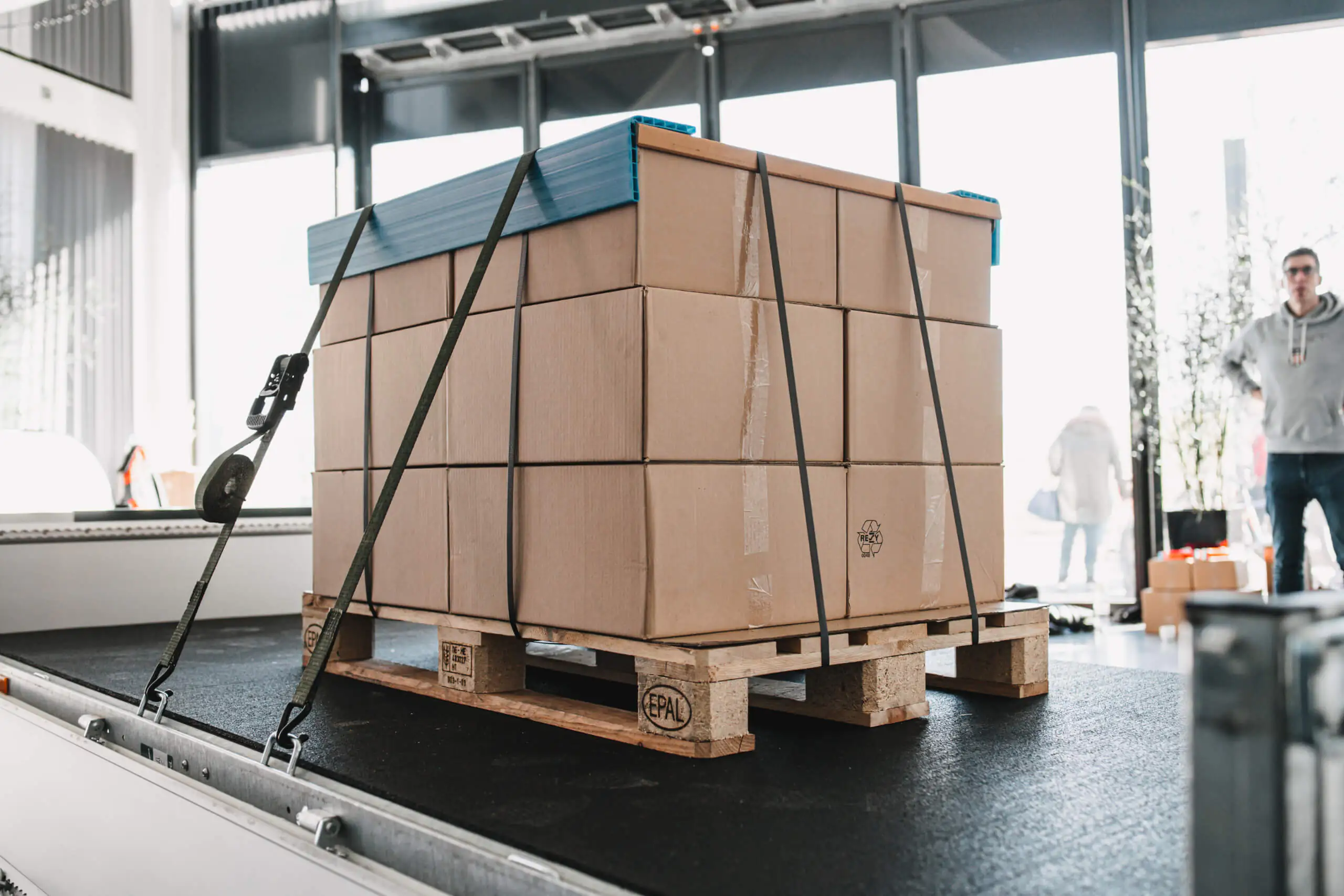
Stacking the packages (goods) correctly on the pallet is crucial for optimum load securing and correct pallet transport. Find out what you need to bear in mind when stacking pallets.
Correct pallet stacking:
- They must not be pushed apart or damaged by their own weight.
- It should be noted that multiple layers are stacked together, as this is the only way to ensure a secure connection.
- Anti-slip interlayers must be used under each layer (anti-slip mats).
- It is important that if small gaps appear between packages, they must be arranged in a staggered manner.
- Loading gaps greater than 3 cm should be filled with stowage cushions, for example.
- Select suitable outer packaging for your package. Particularly in the case of sensitive goods, it is essential to choose optimal, secure and form-fitting packaging.
