
 Ladungssicherung


 Industrie & Logistik


 Planen & Netze


 Urlaub & Freizeit


Overloading of lorries, cars and trailers
Lesezeit: 8 Minutes
Aktualisiert am: 30.07.2025
-
Overloading in transport poses a significant risk and, if load regulations are disregarded, can result in heavy fines and driving and transport bans.
-
Overloading occurs when the permissible total weight of the vehicle is exceeded, which significantly increases the risk of accidents.
Fachtexte von
Ladungssicherungs-Profis

Dangers of overloading
Overloading is one of the greatest dangers in transport and road traffic. Violations of the applicable loading regulations therefore result in heavy penalties for the vehicle owner and driver in the form of fines and driving and transport bans. If vehicles start to sway or even tip over due to overloading, this poses a serious danger to all road users and the environment. Overloading is caused by exceeding the permissible total weight of the vehicle. Therefore, always check the permissible total weight of your lorry, car, trailer, caravan or motorhome before loading.

Consequences of overloading
In addition to penalties in accordance with the catalogue of fines, overloading has several negative effects on vehicle safety:
- the braking distance increases,
- When braking hard, it takes longer for the car to come to a standstill or it may start to skid.
- Overloading has a negative effect on handling, making steering more difficult.
- The increased weight can cause tyres to burst and place excessive strain on the vehicle's engine.
Permissible total weights for lorries/cars according to the Road Traffic Regulations (StVO)
In addition to other factors, the gross vehicle weight rating (GVWR) of the vehicle is the primary factor in calculating the weight of cargo that may be transported without risking a fine. Information about the gross vehicle weight rating can be found in the vehicle registration document for cars, lorries, trailers, caravans or motorhomes. The following regulations apply to passenger cars:
- Permissible total weight without trailer: less than 2.8 tonnes for a light passenger car
- ...without trailer: less than 3.5 tonnes for heavy passenger cars (e.g. vans)
- ...with trailer/load (T/L): Motor vehicles with a maximum authorised mass of less than 3.5 tonnes and trailers with a maximum authorised mass of less than 750 kilograms
- ...with T/L: Motor vehicles with a maximum authorised mass of less than 3.5 tonnes and trailers with a maximum authorised mass of more than 750 kg (if the weight of the trailer is not greater than its own weight and the total weight of the towing vehicle and trailer does not exceed 3.5 tonnes)
The following provisions apply to lorries/buses:
- GVW without trailer: less than 7.5 tonnes for light trucks
- ...without trailer (A): less than 18 tonnes for heavy goods vehicles
- ...with trailer/load (T/L): 18 t for motor vehicles and trailers with two or fewer axles
- ...with T/L: 25 t for motor vehicles with three-axle A
- ...with T/L: 36 t for motor vehicles with four-axle A
- ...with T/L: 40 t for motor vehicles with five or six axles A
- ...with (T/L): 44 t for three-axle motor vehicles with two- or three-axle trailers (combination of semi-trailers)
How can overloading be avoided?
Avoid excessive loads in cars
To avoid risking penalty points and fines, the total weight of the loaded car should be calculated. To do this, subtract the empty weight of the vehicle (without driver, including on-board tools and a full tank) from the permissible total weight. The difference is the maximum payload weight. All occupants must be taken into account in the calculation. If you are travelling on holiday with a roof rack or roof box, you must also take into account the weight of the load on the roof. You should also know how much weight you are allowed to transport on the roof of your vehicle. For example, a Mercedes A-Class can carry 50 kilograms and a VW Golf 75 kilograms. If in doubt, you can find this information in your car's owner's manual or contact the vehicle manufacturer. If you suspect that your vehicle's total weight has been exceeded, have it weighed. Neither the TÜV nor DEKRA offer this service, but you can have your vehicle weighed at recycling centres or anywhere where lorries are weighed. You will usually pay between £5 and £15 for this service. Please note, however, that if you are overloaded on the way to the weighbridge, you may be fined if you are stopped by the police. Tip: It is safer to weigh all your luggage on your scales at home, add the weight of your fellow passengers and add a few extra kilos as a safety buffer.
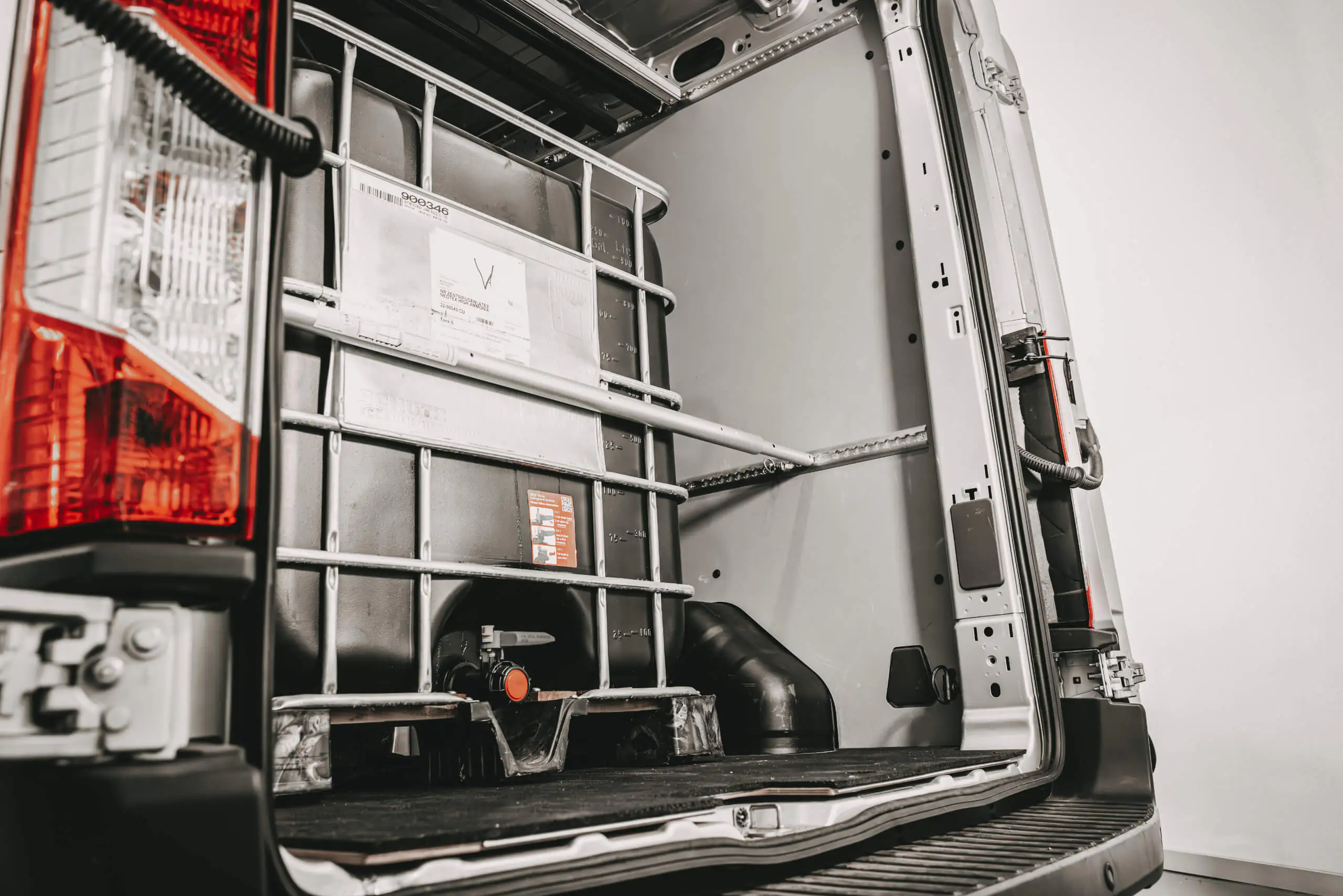
Avoid overloading car trailers
Before loading your trailer, always check the permissible towing capacity specified in the vehicle documents. You will find this information in the following documents:
- In the vehicle registration document, you will find the braked towing capacity under number 28.
- The unbraked towing capacity is listed under number 29 in the vehicle registration document.
- In the registration certificate Part I, you will find the braked towing capacity under O.1.
- The unbraked trailer load is specified under O.2 in the registration certificate, Part I.
In addition, the drawbar load must be observed, which can usually be found on drawbar load plates in the tailgate of the towing vehicle and on the rear panel of the trailer. The drawbar load should always be utilised to the full but not exceeded, as otherwise the stability of the entire combination (towing vehicle + trailer) is compromised when driving.
Do not overload motorhomes and caravans
Motorhomes and caravans have considerable potential for overloading. Luggage, provisions, camping chairs and numerous accessories need to be stowed away. Drivers should therefore always keep an eye on several values: the towing capacity, the permissible total weight and the permissible axle load. The towing capacity should always be the specified maximum value, whereby the lower value of the two vehicles is decisive when combining a caravan and a car. The load should be stored in front of the axle. Load distribution ensures that the combination or motorhome can be driven as stably as possible.
Calculation of axle load
The axle load for car trailers is calculated from the actual mass (unladen weight plus payload) divided by the number of axles. In general, the following formula applies to the calculation of the axle load: Axle load = (unladen weight + load – drawbar load) / number of axles This formula can be used for trailers with a rigid drawbar, central axle or tandem axle. The support load plays an important role in single-axle trailers, but becomes less significant in multi-axle trailers. If the trailer does not have a continuous axle and the wheels are instead connected by a single, short axle, the above formula may not be used. In this case, the total mass (unladen weight + load) is divided by half the number of wheels.
Avoid overloading lorries
The load factors mentioned above also apply to lorries and lorry trailers when calculating the permissible payload. However, there are a few special considerations to bear in mind when calculating the axle load. Since lorries usually have more than two axles, the distribution of the load in the towing vehicle and trailer must be taken into account in accordance with a load distribution plan. For this purpose, hauliers use computer programmes to create a load plan that calculates the load distribution in the lorry. In accordance with Section 34 of the Road Traffic Licensing Regulations (RTLR), the legislator has laid down values that describe the maximum axle load and apply to all motor vehicles and trailers with pneumatic or rubber tyres. Maximum permissible axle load:
- Axle type / in tonnes
- Single-axle vehicle / 10
- Powered single-axle vehicle / 11.5
- Double-axle trailer, distance < 1 metre / 11
- Double-axle trailer, distance < 0 > 1 metre / 11
- Double axle, distance from 1.3 m to 1.79 m / 18
- Double axle, distance of 1.8 m or more / 20
- Three-axle vehicle, distance < 1.3 m / 21
- Three-axle, distance over 1.3 m to max. 1.4 m / 24
List of fines for truck overloading
According to the catalogue of fines for lorries, drivers of lorries with a maximum permissible weight of up to 2 tonnes face the following fines and points in the driving suitability register of the Federal Motor Transport Authority (KBA) in Flensburg if they exceed the limit:
Exceeding the maximum permissible weight by
- 2 to 5% = 30 € fine
- over 5% = 80 € / 1 point
- ...10 % = 110 € / 1
- ...15 % = 140 € / 1
- ...20 % = 190 € / 1
- ...25 % = 285 € / 1
- ...30 % = 380 € / 1
The vehicle owner faces the following penalties Is the maximum permissible weight exceeded by
- 2 bis 5 % = 35 € fine
- over 5 % = 140 € / 1 point
- ...10 % = 235 € / 1
- ...15 % = 285 € / 1
- ...20 % = 380 € / 1
- ...25 % = 425 € / 1
- ...30 % = 425 € / 1
List of fines for overloading passenger cars
Unlike the regulations for trucks in the 2020 catalogue of fines, only the driver is liable in the event of a private car being overloaded. According to the Federal Motor Transport Authority's catalogue of fines for cars, the following penalties apply to drivers in the event of a car with a permissible gross weight of up to 7.5 tonnes or a trailer of up to 2 tonnes being overloaded: Overloading a car by
- over 5 % = 10 € fine
- ...10 % = 30 €
- ...15 % = 35 €
- ...20 % = 95 € / 1 point
- ...25 % 140 € / 1
- ...30 % 235 € / 1
Securing loads in vehicles
In addition to overloading trucks or cars, inadequate load securing is another cause of serious road accidents. Load securing is covered by laws (e.g. StVO § 22 ‘Load’), guidelines (VDI 2700), regulations (DGUV) and European standards (DIN EN). According to the Road Traffic Regulations, the load in the vehicle must not roll, slip, tip over, fall down or cause avoidable noise. To this end, it must be secured in accordance with the recognised rules and techniques of load securing. As in the case of overloading, the driver and vehicle owner, as well as the shipper in logistics, face penalties in accordance with the catalogue of fines in the event of non-compliance and in the event of a police check.
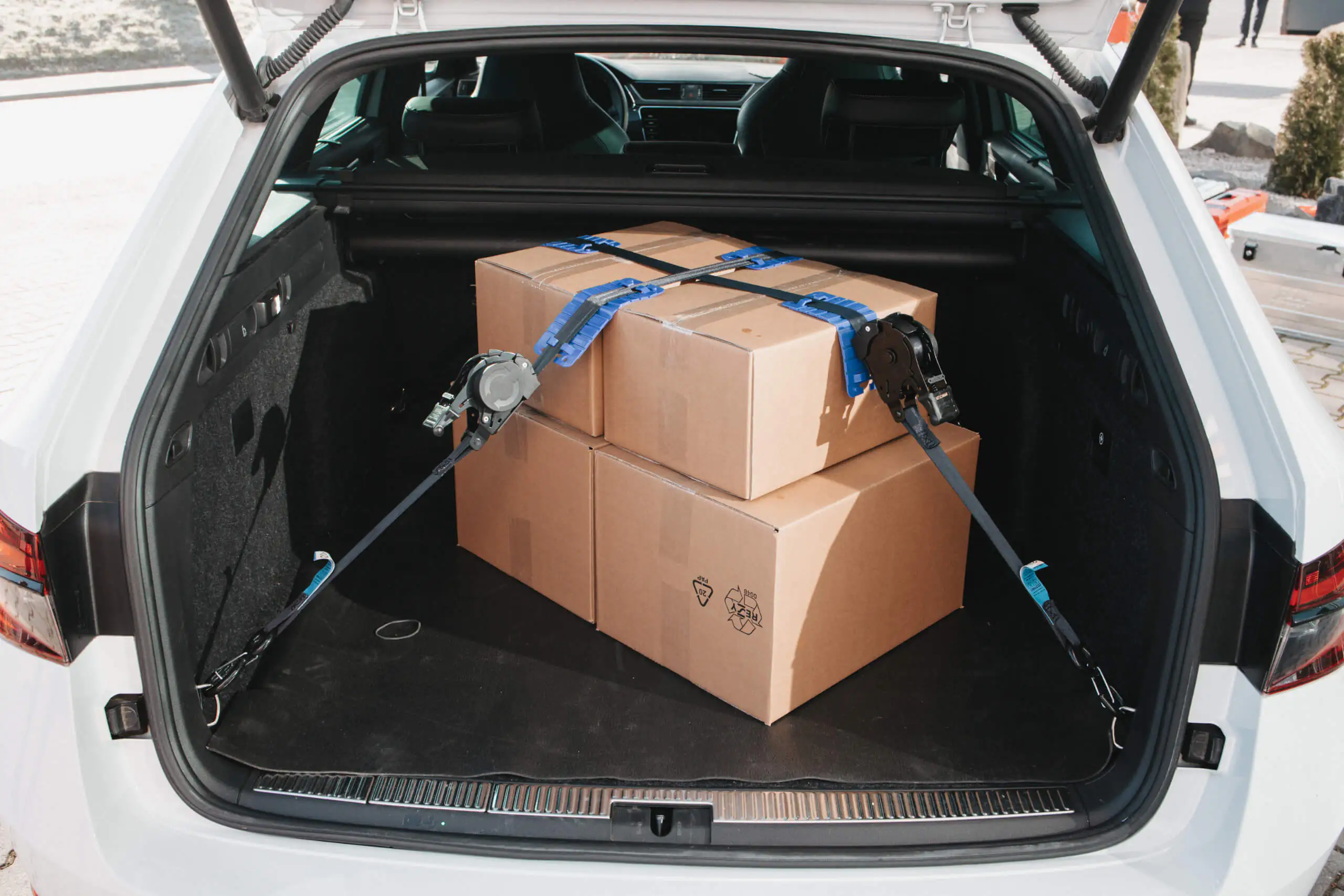
Securing loads in cars
When travelling in your own car, you should not only pay attention to the total weight, but also ensure that your luggage is stowed away properly and securely. This is also required by Section 22 of the German Road Traffic Regulations (StVO) ‘Load’, which also applies without restriction to passenger cars. Tip: Heavy loads should be placed at the bottom of the vehicle, and in estate cars, the interior of the vehicle should be separated from the boot by a net. This effectively prevents luggage from sliding around when braking and becoming a projectile in the car.
