
 Ladungssicherung


 Industrie & Logistik


 Planen & Netze


 Urlaub & Freizeit


Load distribution plan
Lesezeit: 6 minutes
Aktualisiert am: 08.08.2025
-
A load distribution plan is essential for shippers, drivers and owners of lorries or semi-trailers to ensure the correct weight distribution of the load.
-
Even load distribution is necessary to prevent damage to the vehicle, people and materials and to ensure that the permissible payload is not exceeded.
Fachtexte von
Ladungssicherungs-Profis

Load distribution plan: Correct loading of lorries, articulated lorries and trailers
As a shipper, driver or owner of lorries or semi-trailers, you must always be aware of the weight distribution of your load. The best tool for this is a load distribution plan, which should be carried with you on every journey. Why is a load distribution plan so important for load securing? Quite simply, the permissible payload of a lorry or articulated lorry may only be applied if the centre of gravity of the load is within a certain area of the loading area. The load must therefore be distributed as evenly as possible, otherwise there is a risk of damage to the vehicle, people and materials.
The consequences of incorrect load distribution:
- Reduced driving stability due to axle loads exceeding or falling below the specified limits
- Reduced braking ability due to reduced tyre grip
- Accelerated tyre wear
- tyre damage
- Overloading of drive axle (tractor unit) or front axle (lorry)
You probably know from your own experience that it is not always possible to distribute the load evenly: it is difficult to locate the centre of gravity precisely in the area of the loading area where the vehicle has its permissible payload. Depending on the type of goods being transported, the centre of gravity is either more towards the front or the rear of the loading area. Depending on the situation, the available payload may then be higher or lower than the maximum permissible load, because more or less weight also means exceeding or falling short of the permissible axle load – and thus an increased risk of accidents.
Calculate load distribution plan according to VDI 2700
To prevent a reduction in driving stability or accidents caused by tyre and axle damage, the VDI has developed precise specifications for creating a load distribution plan (VDI 2700 Sheet 4). The following section summarises the most important information from the VDI specifications. Calculation of a load distribution plan:
- Axle load(s) empty in tonnes
- Maximum axle load(s) in tonnes
- Minimum axle load(s) in %
- Wheelbases in metres
- Length of loading area in metres
- Distance between front axle and front wall in metres
- Distance between front axle and rear axle in metres
- Distance between centre axle and rear axle in metres (if applicable)
To find out the above information, please check the vehicle's registration certificate (until 2005: vehicle registration document) or contact the manufacturer. You can determine the axle weights yourself by weighing the vehicle.
Use load distribution plan for load securing
Once you have determined the basic data for your vehicle, calculate the possible payload depending on the required or permissible axle loads at as many points on the loading area as possible. Then transfer the calculated values as points to a drawing that shows a simplified cross-section of your vehicle. Note the length of the loading area in metres horizontally and the load weight in kilograms or tonnes vertically. Then connect the points to each other – and voilà: you have a graphical curve, known as the load distribution plan. The plan shows you the maximum payload for each point along the centre longitudinal axis of the loading area and the respective distance of the load centre of gravity from the front wall. Note: The load must always be distributed in such a way that the centre of gravity lies within the curves of the load distribution plan!

Load distribution for symmetrical loads
If the cargo is symmetrical, it is relatively easy to determine the ideal position of the centre of gravity. Some cargo packaging even often features a centre of gravity symbol. However, not all packaging manufacturers are so accommodating: as a rule, you have to work out the centre of gravity of your load yourself. The centre of gravity of a load on the loading area may only be located where a payload is possible that is at least as high as the centre of gravity of the load.
It becomes more complicated if you have to distribute the load for transport because it consists of several goods of different sizes. In this case, it is necessary to determine the overall centre of gravity of the goods.
You can calculate the overall centre of gravity using the formula:
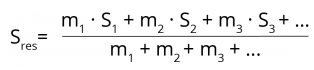
Sres stands for the distance of the overall load centre of gravity from the front wall. M denotes the weight of the respective load in kilograms or tonnes. S denotes the distance of the load centre of gravity of the respective load from the front wall in metres.
Example of ideal loading
For example, if you have three boxes weighing 2 tonnes, 4 tonnes and 5 tonnes, and the centre of gravity of the boxes is 1 metre, 2.5 metres and 4 metres behind the front wall, the overall centre of gravity of the load is 2.9 metres from the front wall.

However, the calculated centre of gravity of a trailer or articulated lorry load is often not within the payload area of the loading space. In this case, there is only one solution: you must arrange the individual load items so that their centre of gravity lies within the appropriate area of the loading space. To find this area, simply take a look at your load distribution plan. Note: A separate plan should be drawn up for each transporter or vehicle body, as the data varies depending on the vehicle type.
