
 Ladungssicherung


 Industrie & Logistik


 Planen & Netze


 Urlaub & Freizeit


Lashing down
Lesezeit: 1 minute
Aktualisiert am: 03.12.2025
-
Definition: Lashing down is a force-based method of securing loads, in which the load is pressed down onto the loading area by the pre-tensioning forces of lashing straps.
-
Effect: Lashing down increases the friction between the load and the loading area, preventing slippage.
-
Objective: Securing loads in road transport and preventing damage to transported goods and vehicles.
-
Advantages: Fast and most popular way to secure dimensionally stable load units on the loading area.
Fachtexte von
Ladungssicherungs-Profis
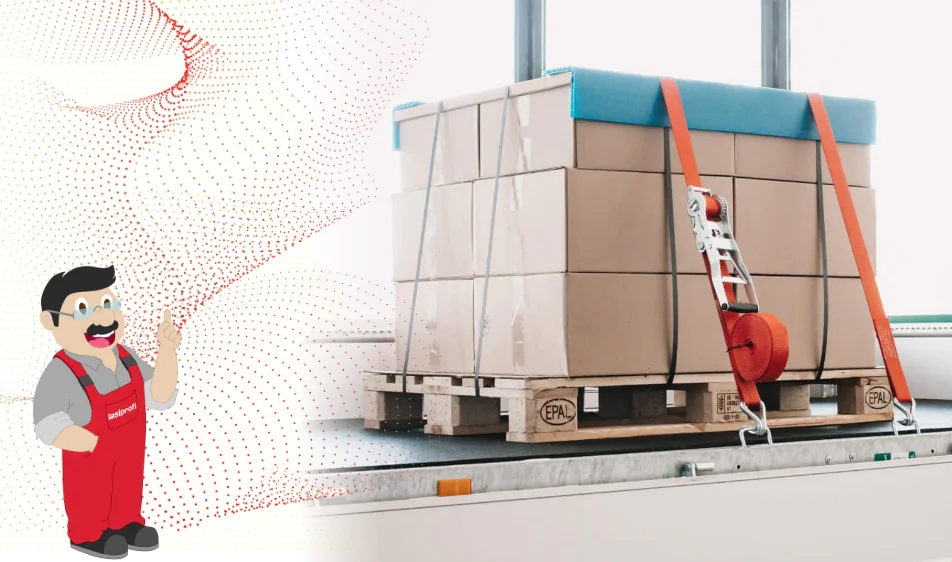
The topic in brief
- Application:
- Use of anti-slip underlays (e.g. anti-slip mats) to increase the coefficient of friction.
- Use of suitable lashing equipment (e.g. lashing straps/tensioning straps in accordance with EN 12195-2, lashing chains in accordance with EN 12195-3) and tested lashing points (DIN EN 12640).
- The selection of the right aid and the correct number depend on weight, coefficient of friction and acceleration coefficients.
- The lashing angle (α) between the lashing equipment and the loading area has a significant impact on effectiveness: the steeper the angle, the more effective it is.
- Attach suitable lashing aids over the transported goods, tighten the ratchet, check and, if necessary, retighten during the journey.
- When using multiple lashing straps, these must be attached alternately.
- According to Section 22(1) of the Road Traffic Regulations (StVO): ‘The load ... must be stowed and secured in such a way that even in the event of emergency braking or sudden evasive manoeuvres, it cannot slip, fall over, roll back and forth, fall down or cause avoidable noise. The recognised rules of technology must be observed.’
- Aids must comply with standards such as DIN EN 12195-2 (lashing straps/tensioning straps) or DIN EN 12195-3 (lashing chains).
- Visual and functional inspection of load securing equipment before each use
- Lashing straps (with ratchet and end fitting) in accordance with standards such as EN 12195-2; marking of STF (Standard Tension Force) and SHF (Standard Hand Force) in daN and LC (Lashing Capacity).
- Lashing chains in accordance with standard EN 12195-3; suitable for heavy loads (always use with edge protectors).
- Accessories such as anti-slip mats, edge protectors, tested lashing points and loading aids as a supplement to safe and effective lashing.
The topic in detail
What is lashing down?
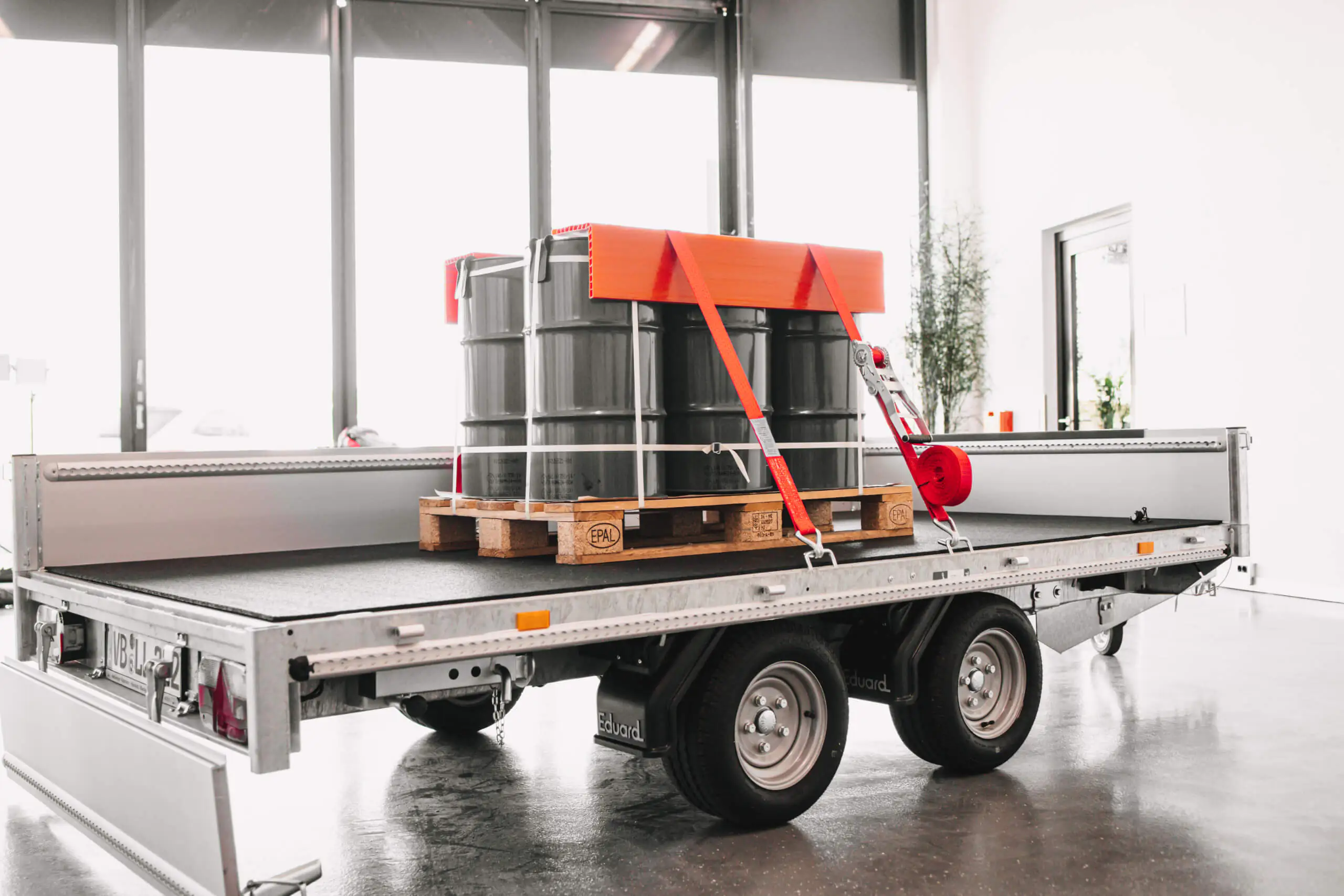
Lashing down is a load securing technique in which the cargo is secured to the loading area using lashing equipment (e.g. lashing straps): the cargo is pressed downwards, which increases the weight force, i.e. the force with which the load rests on the loading area. In combination with an anti-slip mat, the friction between the load and the loading area is increased, effectively preventing slippage. Unlike form-locking or direct lashing, where the load is mainly held in position by the maximum tensile force (LC) of the lashing equipment, tie-down lashing relies on increasing the friction between the load and the ground. Technically, this means that a lashing strap is placed over the load and attached to approved lashing points. Tensioning (pre-tension force = STF) generates a force that lashes the load down.
How does lashing down work? An overview of the technique
3.1 Physical principle of operation
- When tensioning the lashing equipment, the standardised hand force (SHF) of 50 daN generates a pre-tensioning force (STF) that presses the load downwards, thereby increasing the weight force.
- This increases the force (weight force perpendicular to the loading area), which in turn increases the friction force: FR = FG ⋅ µ in daN. The friction force is calculated from the coefficient of friction multiplied by the weight force of the load.
- The increased friction force prevents the load from slipping when dynamic forces are applied during driving.
- The lashing angle α (measured between the loading area and the aid in the vertical plane) influences effectiveness: the greater the lashing angle when lashing down, the more effective it is. An angle of at least 35° is recommended.
3.2 Application steps
- Prepare the load: Distribute the load evenly (load distribution plan) and, if possible, position it so that it is form-fitting (no gaps).
- Use anti-slip underlays: Anti-slip mats or coverings increase the coefficient of friction μ and improve the effectiveness of lashing down (min. μ=0.6).
- Select equipment: Suitable lashing straps or chains with sufficient lashing capacity (STF) and in good condition.
- Select lashing points: Vehicles must have tested lashing points (e.g. in accordance with EN 12640).
- Perform tensioning: Place the lashing equipment correctly over the goods to be transported, operate the ratchet or tensioning mechanism, and generate pre-tensioning force.
- Check: Check that the load is secure and that there is no damage or twisting of the webbing (ready for replacement).
- Follow-up check during the journey: Even after a short journey, the load may settle due to normal driving movements. The driver must therefore retighten the straps and check whether anything has come loose or shifted.
3.3 Notes on calculation
- The actual pre-tensioning force FV required for lashing down is specified in DIN EN 12195-1. The calculation includes the coefficient of friction, acceleration factor, load weight, safety factor, lashing angle, etc.
- Particularly in the case of low frictional resistance (e.g. metal on metal), the effort required increases, as many lashing devices or high pre-tensioning forces are needed to achieve the same effect.
What should be considered when lashing down loads? Practical recommendations
- Use anti-slip mats: they increase the coefficient of friction and reduce the number of lashing straps required.
- Consider the lashing angle: a steeper lashing angle (relative to the loading area) increases effectiveness. Observe a minimum angle of more than 35°.
- Do not tension too little or too much: insufficient pre-tensioning force reduces the effect; excessive tension can damage the load, transport surface or equipment.
- Use good lashing equipment and standardised lashing points: Damaged straps or unsuitable lashing points can significantly compromise safety.
- At least two lashing devices per free-standing loading unit: general practical value for increasing safety. These can prevent the load from ‘slipping’ under the lashing strap. They should be attached alternately.
- Use of edge protection angles: The improved sliding properties (K factor) when using edge protection result in better pre-tensioning forces when lashing down on the opposite side of the tensioning element. They also serve to protect the load and strap material.
- Documentation and evidence: For commercial transport, it is advisable to provide evidence of the security methods used (e.g. photographs, test reports).
- Regular checks while driving: Shortly after starting your journey, especially after heavy braking, cornering or during long journeys.
What are typical mistakes when lashing down loads?
- A low coefficient of friction (e.g. smooth metal surfaces) makes lashing down considerably more difficult: a large number of lashing devices are required, or the method reaches its limits.
- Unsuitable lashing equipment or lashing points: Worn-out straps or unsuitable vehicle superstructures result in inadequate load securing. Worn-out or damaged straps must not be used.
- Incorrect lashing angle or unfavourable geometry: if the angle is too flat, the pre-tensioning force is significantly reduced.
- Unaccounted for tipping or rotational forces: For load units at risk of tipping, lashing down alone is sometimes not sufficient. Additional securing measures are required in such cases, e.g. form-fit fastening or head lashing.
- Damage to the load: Excessive preload can damage the load, especially sensitive goods.
- No follow-up checks or maintenance: Lashing equipment is subject to rapid wear and tear when used frequently, and a lack of checks increases the risk. Lashing straps must be subjected to a brief check before each use.
FAQ – Frequently asked questions
How much lashing force do I need to apply when lashing down?
With a dimensionally stable load unit, pre-tensioning forces can be applied by ratcheting, as indicated on the blue lashing strap label – provided that the load, weight and lashing points are coordinated. A manual force (SHF) of 50 daN is required to achieve the specified pre-tensioning force (STF). If the lashing strap is not lashed to the maximum possible extent, this is referred to as holding down.
What happens if the lashing force is too low?
If the lashing force is insufficient, there is a risk that the load will shift during transport, which can lead to damage or even accidents.
Can I also use lashing down for more sensitive goods?
If there is a risk that the goods could be damaged by lashing down, other known lashing methods should be used. These would be form-fitting or direct lashing methods. By increasing friction in the form of anti-slip mats, lashing forces can be reduced and sensitive goods can thus also be protected.
How often do I need to check the load while driving?
Before starting the journey, the driver and shipper/consignor must check that the load is secure. Even when leaving the loading yard, the load may shift due to the movement of the vehicle. It is advisable to check that the load is secure shortly after starting the journey and during the driver's statutory rest breaks.
What to do if the lashing points on the vehicle are insufficient?
Other aids for securing loads include locking systems Partition wall locks, load beams, locking beams and clamping rods are now suitable and frequently used load securing items. They make use of the principle of form closure: they are placed close to the load and thus prevent it from shifting on the loading area. The use of anti-slip mats is recommended.
Are low and diagonal lashing the same thing?
No. When lashing down, a vertical force is generated that presses the transported goods down onto the loading area. This method is particularly suitable for dimensionally stable freight such as palletised goods, crates or furniture. This is referred to as a force-fit securing method. In contrast, diagonal lashing is a form-fit securing method. This technique is particularly useful for irregularly shaped or round loads, where the cargo must be secured both in the direction of travel and laterally or against tipping to prevent any movement.
