
 Ladungssicherung


 Industrie & Logistik


 Planen & Netze


 Urlaub & Freizeit


Friction lock by lashing down the load
Lesezeit: 5 minutes
Aktualisiert am: 11.10.2025
Fachtexte von
Ladungssicherungs-Profis
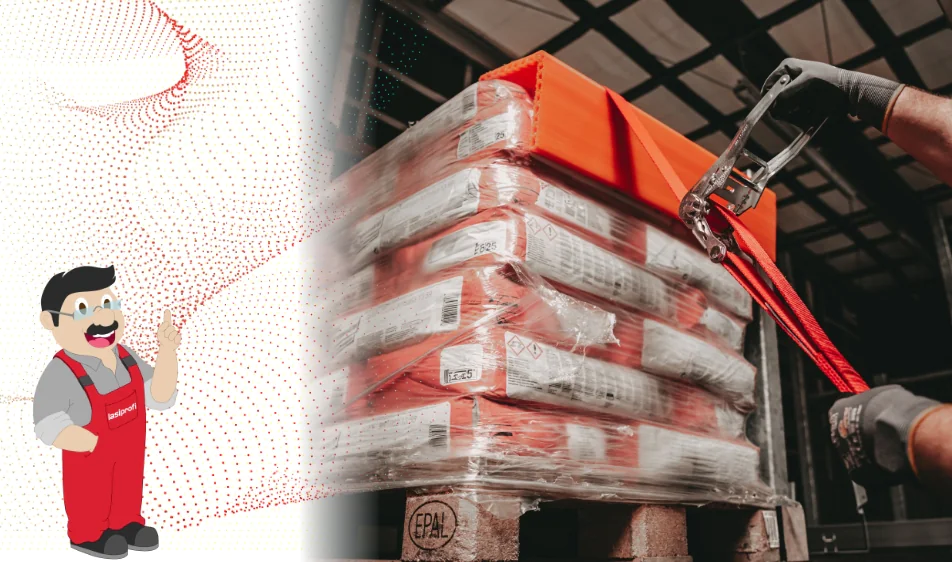
Friction lock by lashing down the load
Proper and correct load securing requires knowledge of and compliance with the recognised rules of load securing techniques. Probably the best known and most frequently used method of lashing and securing loads on the loading area of a lorry or trailer is tie-down lashing, a force-fit load securing method. Here, the goods are pressed onto the loading area in what is known as a ‘force-fit’. This is done with lashing straps or tensioning straps, which are hooked into existing lashing eyes in the loading floor and lashed over the load.
The angle when lashing down loads in load securing
Another factor is of utmost importance when lashing down loads. The lashing angle α (see diagram). If it is between 83° and 90°, optimum preload force is generated. If the angle α is < 83°, the effective preload force decreases progressively. Angles α below 30° should be avoided at all costs. In summary, it can be said that the flatter the angle α, the less preload force acts on the load!
Nature and properties of lashing straps
Choosing the right lashing strap for a tie-down lashing is crucial. The standard tension force (STF) is important here. This is applied to the strap via the standard hand force (SHF), the hand force (in daN (decanewtons)) using a ratchet. The lashing capacity, which can be found on the lashing strap label, is also important. The label must comply with European standard EN 12195 and contain the following information: In the concealed section of the label:- Name and address of the manufacturer or supplier
- LC (Lashing Capacity): Lashing force, specified in daN (decanewtons)
- Period of manufacture (e.g. the year)
- webbing material
- Traceability code
- Stretching of the webbing during LC
- Standard number DIN EN 12915-2
- Name and address of the manufacturer (including logo, website address and place of production, if applicable)
- Tissue material, this is also indicated by the colour of the strap, whereby:
- Traceability code of the lashing equipment
- Stretch in per cent
- European standard (DIN EN 12195-2)
- Permissible lashing force of the lashing device with symbol (LC (LC value) = Lashing Capacity) in daN (1 daN = 10 N = 1 kp = 1 kg); refers to the maximum force with which a lashing strap may be loaded when used in a straight pull.
- Standard hand force (SHF); refers to the force required to tighten the ratchet
- Normal clamping force (STF = Standard Tension Force); value of the preload force applied, which is generated by hand force with the lever ratio of the clamping element.
- Note: Must not be used for lifting!
- Length of the lashing device: total length / length of the part that does not contain the ratchet / length of the fixed end, i.e. the short part that contains the tensioning element or ratchet.

Further aids for lashing down
In order to achieve the best possible results when lashing down loads, it is very important to use additional load securing aids. Among other things, the use of anti-slip materials such as anti-slip mats or anti-slip pads is recommended. These increase the coefficient of sliding friction and the frictional force between the pallet and the loading floor or between the load and the vehicle floor, thus preventing the cargo from slipping.
