
 Ladungssicherung


 Industrie & Logistik


 Planen & Netze


 Urlaub & Freizeit


Basic rules for securing loads
Lesezeit: 3 minutes
Aktualisiert am: 09.08.2025
Fachtexte von
Ladungssicherungs-Profis
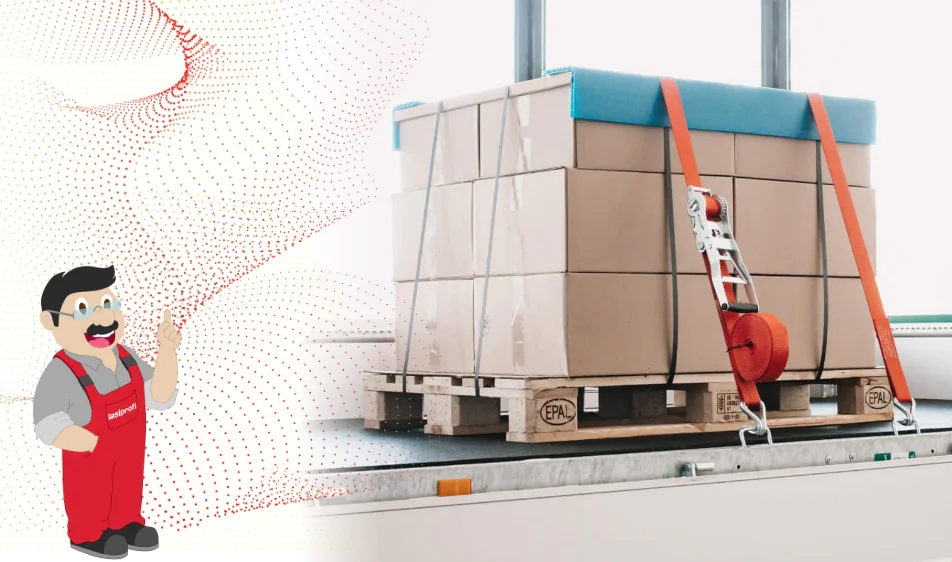
Inadequate or missing load securing is the cause of many avoidable accidents. German insurance companies estimate that approximately 20 per cent of all traffic accidents are due to inadequate or missing load securing.
Every change in a vehicle's speed and direction causes forces (centrifugal, braking and deceleration forces) to act on the load, which can cause it to slip, roll, tip over or fall.
This can result in the driver losing control of the vehicle, the vehicle overturning or the load destroying the driver's cab. This endangers not only the driving personnel, but also all other road users.
To prevent such accidents and damage, the following basic rules apply to every transport operation:
- Each load requires a suitable vehicle that is capable of safely absorbing the forces generated by the load thanks to its structure and equipment.
- The load centre of gravity should be as close as possible to the longitudinal centre line of the vehicle and should be kept as low as possible. Heavy loads should be placed at the bottom, light loads at the top.
- The permissible total weight and permissible axle loads must not be exceeded, and the minimum axle load of the steering axle must not be undercut. In the case of partial loads, care should be taken to distribute the weight so that each axle is loaded proportionally.
- The load must be stowed or secured using suitable aids in such a way that it cannot slip, roll, fall over, fall down or cause the vehicle to tip over under normal traffic conditions. Emergency braking and sharp evasive manoeuvres by the vehicle, as well as unpredictable poor road and weather conditions, are considered normal traffic conditions.
